


Page 59 - Costellazioni 5
P. 59
PATRICK COLM HOGAN, Affective Space and Emotional Time

                influence, Chinese literary tradition seems to be a particularly apt for
                this task. Within that tradition, one of the most famous works
                throughout the world (due in part to a translation by Ezra Pound) is
                a poem by Lǐ Bái, which also happens to be a work that extensively
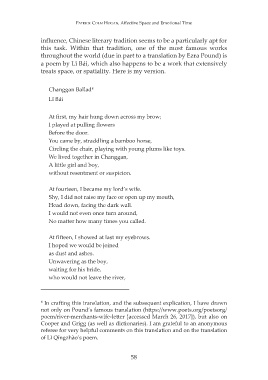
                treats space, or spatiality. Here is my version.


                   Changgan Ballad 8
                   Lǐ Bái


                   At first, my hair hung down across my brow;
                   I played at pulling flowers
                   Before the door.
                   You came by, straddling a bamboo horse,
                   Circling the chair, playing with young plums like toys.
                   We lived together in Changgan,
                   A little girl and boy,
                   without resentment or suspicion.


                   At fourteen, I became my lord’s wife.
                   Shy, I did not raise my face or open up my mouth,
                   Head down, facing the dark wall.
                   I would not even once turn around,
                   No matter how many times you called.


                   At fifteen, I showed at last my eyebrows.
                   I hoped we would be joined
                   as dust and ashes.
                   Unwavering as the boy,
                   waiting for his bride,
                   who would not leave the river,


                8
                 In crafting this translation, and the subsequent explication, I have drawn
                not only on Pound’s famous translation (h ps://www.poets.org/poetsorg/
                poem/river-merchants-wife-le er [accessed March 26, 2017]), but also on
                Cooper and Grigg (as well as dictionaries). I am grateful to an anonymous
                referee for very helpful comments on this translation and on the translation
                of Lǐ Qīngzhào’s poem.


                                                58

